GEPRC Brand Review: Cinewhoops, Freestyle, and Long-Range FPV Drones
GEPRC covers an unusually wide span of the FPV market, from 50 g micro quads to 7-inch long-range aircraft. We compare the brand's range, specifications, support, ownership demands, and five representative drones.
Our Verdict
One overall score, with the important jobs separated below. Scores reflect the evidence and limitations stated in this review.
What it is and where it fits
GEPRC designs complete FPV drones and a wide supporting ecosystem of frames, motors, flight electronics, video hardware, receivers, batteries, chargers, and replacement parts for cinematic, freestyle, racing, micro, and long-range use.
- Micro, cinewhoop, freestyle, racing, and long-range aircraft families
- Strong current selection of DJI O4 and O4 Pro configurations
- PNP, ELRS, and TBS receiver choices on many models
- Detailed model-level hardware and battery specifications
- Broad catalog of frames, electronics, motors, batteries, and spares
Reasons to buy
- Exceptional range across FPV aircraft sizes and missions
- Useful specification transparency on current product pages
- Multiple radio and video-system configurations
- Replacement frames and core components are widely represented
- Dedicated downloads and setup documentation
Reasons to compare
- Steep ecosystem and setup learning curve for newcomers
- Aircraft price excludes much of the equipment needed to fly
- Flight-time and range figures are not standardized independent tests
- Direct-store defect warranty is stated as only 30 days from delivery
- International shipping, tax, and import costs can be significant
Products reviewed in this guide

GEPRC T-Cube18 HD O4 Quadcopter
The T-Cube18 is the most portable and lowest-mass option in this comparison. It reduces the physical consequences of learning compared with a 5-inch or 7-inch aircraft, but it is not a complete ready-to-fly kit and still requires compatible radio, goggles, batteries, charger, setup, and safe operating judgment.
GEPRC Cinebot25 V2 O4 Pro Quadcopter
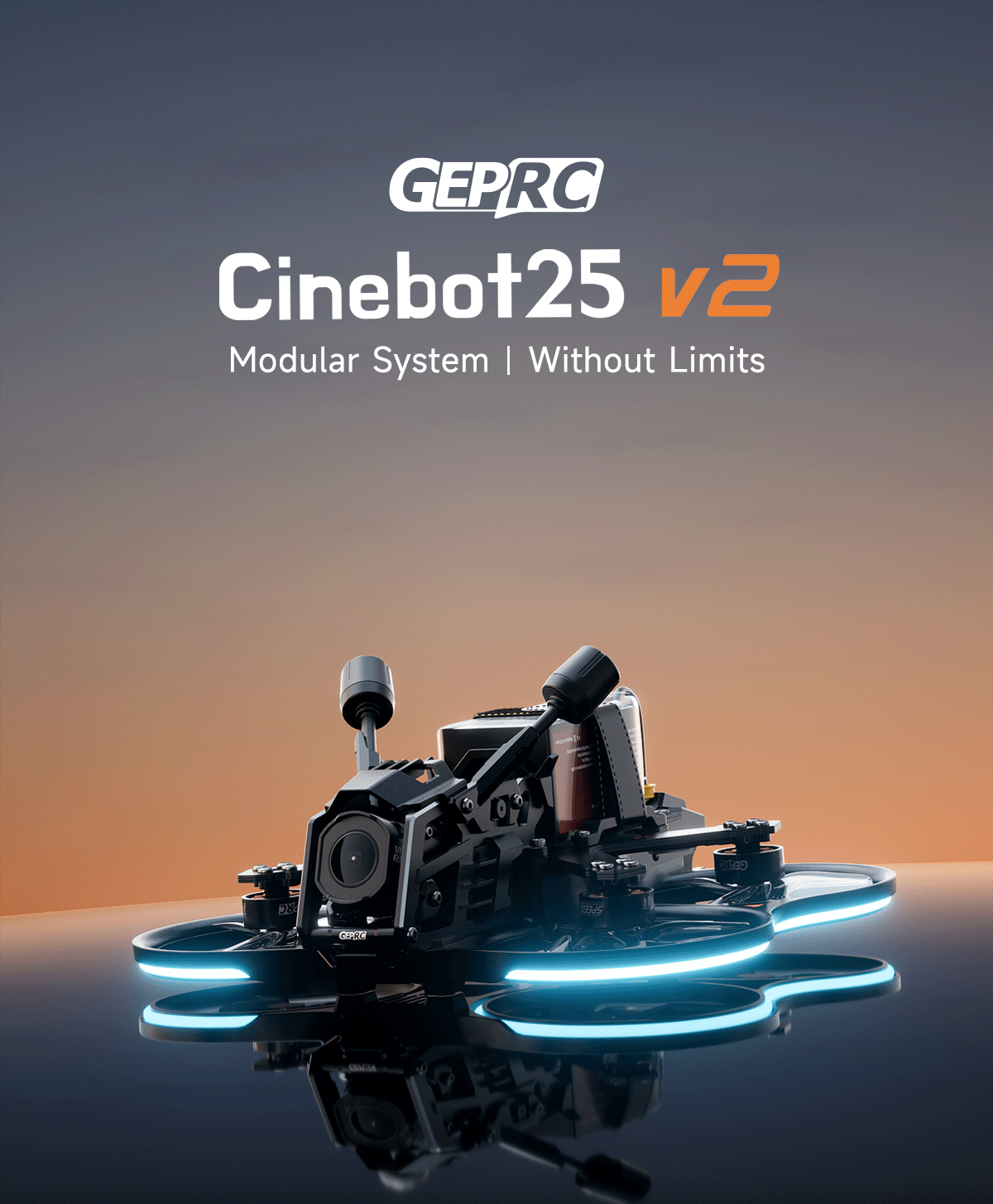
Cinebot25 V2 combines O4 Pro imaging with a relatively compact guarded frame. Its removable suspended video module is a meaningful differentiator for pilots who value vibration isolation and component transfer, while the limited flight-time claim and high system price keep it specialized rather than universal.
GEPRC Cinebot35 O4 Pro Quadcopter
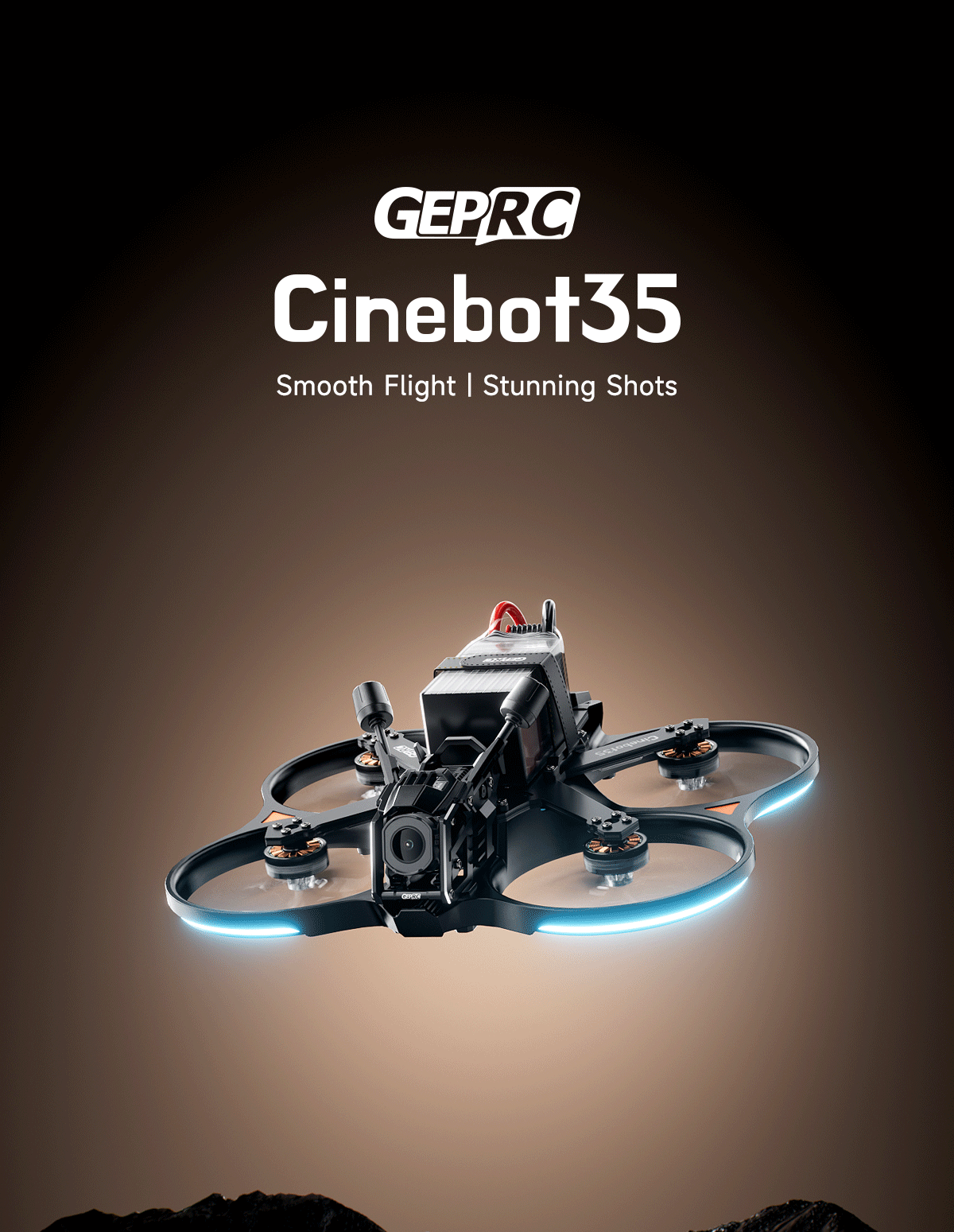
Cinebot35 offers the strongest balance of image system, protected layout, payload potential, and claimed endurance among the cinematic models selected. Its larger mass and 6S power make it more capable than Cinebot25, but also louder, more energetic, and less suitable for genuinely confined spaces.
GEPRC at a glance
GEPRC is a specialist FPV company selling complete drones, frames, motors, flight controllers, ESCs, video-transmission hardware, receivers, antennas, batteries, chargers, and replacement parts. Its official company page says the founder began flying FPV in late 2011 and that the business has grown from a small team to more than 100 people. The current catalog is broad enough to serve cinematic pilots, freestyle flyers, long-range users, racers, builders, and commercial operators.
The brand's strongest advantage is coverage. A buyer can move from a 1.8-inch micro quad to a ducted cinewhoop, a 5-inch freestyle platform, or a 7-inch GPS-equipped long-range aircraft without leaving the same ecosystem. Many current models are offered with DJI O4 video systems and a choice of PNP, ELRS, or TBS receiver configurations. GEPRC also sells many of the underlying frames, motors, stacks, antennas, and batteries separately.
Our editorial rating is 4.2 out of 5. GEPRC scores highly for range, specification detail, configuration choice, and parts availability. It loses points because FPV ownership remains complex, listed flight times are controlled slow-cruise claims rather than standardized real-world results, complete system cost is much higher than the aircraft price alone, and the official direct-sales warranty is limited to 30 days from delivery.
How we assessed GEPRC
This review is based on GEPRC's official company, catalog, product, documentation, shipping, and warranty pages checked on August 1, 2026. Five aircraft were selected to represent distinct uses rather than treating one model as proof of the entire brand: T-Cube18 HD O4 for micro flying, Cinebot25 V2 and Cinebot35 for cinematic work, MARK5 O4 Pro Wide X for freestyle, and MOZ7 V2 O4 Pro for long range.
We have not performed independent flight, crash, RF-range, latency, thermal, vibration, battery-cycle, or durability testing for this article. Flight-time, range, video, and performance statements are identified as manufacturer specifications or claims. Actual results depend on aircraft configuration, firmware, payload, battery condition, radio environment, weather, altitude, pilot technique, and local legal limits.
Prices are snapshots from the official GEPRC USD storefront on August 1, 2026. Receiver choices and other variants can change the final price. Batteries, charger, compatible radio, goggles, spare propellers, tools, shipping, taxes, and import duties may be separate costs. Product photographs are linked directly from GEPRC's official product galleries for editorial identification.
What GEPRC does well
A genuinely broad FPV lineup
GEPRC does not concentrate on one airframe size. Its navigation separates cinewhoops, freestyle, long-range, tinywhoop, racing, and O4 families, while the broader store covers frames, electronics, motors, batteries, chargers, propellers, and accessories. That breadth helps a pilot choose around a mission: guarded propellers for close cinematic work, an open-prop 5-inch platform for freestyle, or a large GPS-equipped frame for efficient cruising.
The five featured products show the scale of that range. The 87 mm T-Cube18 is listed at roughly 50 g, while the 336 mm MOZ7 V2 is listed at roughly 750 g before its large flight battery. They are not interchangeable products. Comparing them by headline camera specification alone would ignore risk, noise, energy, handling, payload, required space, and regulatory consequences.
Detailed model-level specifications
Current product pages normally identify the frame, wheelbase, controller, gyro, ESC, motor, propeller, connector, VTX, receiver options, weight, suggested battery, and claimed flight time. This is materially more useful than a generic promise of smooth video. It helps buyers check battery compatibility, receiver choice, expected weight, replacement parts, and whether the aircraft fits an existing radio or goggle system.
GEPRC also publishes change information on some models. The MOZ7 V2 page, for example, records a July 2025 motor and ESC revision. Buyers should still save the current specification page at purchase because a model name may remain the same while components or bundled accessories change.
Choice of video and receiver configuration
Many current aircraft are sold in PNP or receiver-equipped configurations. PNP generally requires the buyer to supply and install or configure a compatible receiver, while ELRS and TBS variants are intended for corresponding radio ecosystems. DJI O4-equipped models may include either the O4 Air Unit or O4 Air Unit Pro, depending on the aircraft. These names are not interchangeable: camera sensor, weight, recording capability, compatibility, and final cost differ.
This flexibility is valuable for experienced pilots who already own a radio and goggles. It can confuse a newcomer who assumes that a drone listing includes everything required to fly. GEPRC product pages should be read as configuration pages, not as a guarantee of a ready-to-fly kit.
Repair-oriented product ecosystem
Frames, motors, flight electronics, propellers, antennas, batteries, and numerous model-specific parts are listed separately. The MARK5 uses quick-release arms secured by two screws, while the Cinebot25 V2 introduces a removable vibration-damped video module. These choices can make field repair or component replacement more practical than on a tightly integrated consumer camera drone.
Repairability still requires skill. Carbon edges, LiPo batteries, soldering, firmware configuration, motor direction, propeller orientation, and radio failsafe settings all demand care. GEPRC's warranty specifically excludes crash damage, incorrect soldering, unsuitable battery or charger use, unauthorized modification, water ingress, and several other common FPV failure modes.
Where buyers should look more closely
FPV is a system, not a single purchase
A listed aircraft price rarely represents the full cost of flying. Depending on the selected version, a buyer may need a compatible radio transmitter, FPV goggles, batteries, a safe balance charger, charging leads, storage-voltage equipment, spare propellers, tools, and fire-conscious LiPo storage. Long-range models may also require suitable antennas, region-appropriate radio settings, and additional planning equipment.
Compatibility must be checked at the protocol and voltage level. ELRS 2.4 GHz is not the same choice as ELRS 915 MHz, a TBS receiver requires a matching system, and DJI O4 video hardware requires compatible DJI viewing equipment. Battery cell count, capacity, connector, physical size, weight, and discharge capability all matter.
Manufacturer flight times need context
GEPRC lists approximately 3–5 minutes for the T-Cube18, 5–8 minutes for Cinebot25 V2, 10–11 minutes for Cinebot35, 6–8 minutes for MARK5, and up to 25 minutes for MOZ7 V2. The pages state that these figures come from slow-cruise conditions and that actual time varies. Aggressive freestyle, wind, cold weather, heavy cameras, old batteries, and conservative landing voltage can reduce usable time substantially.
Range claims need the same caution. Video-system capability does not guarantee a legal or reliable operational radius. Antenna installation, receiver frequency, RF noise, terrain, obstacles, battery reserve, home-point accuracy, and regulations can become the limiting factors first.
The direct-sales warranty is short
GEPRC's current warranty page states a 30-day period from delivery for defects in material or workmanship. Proof of purchase is required. Confirmed out-of-box defects may lead to a replacement part, while issues after multiple flights may be handled with a discount code. The policy also says some third-party components, including DJI and Walksnail equipment, require support from their respective manufacturers.
This policy places a premium on immediate inspection. Photograph the package, check the exact variant, inspect connectors and fasteners, verify motor and propeller installation, and complete safe bench checks promptly. Do not treat a successful arm or hover test as permission to skip radio failsafe, battery, firmware, and local-rule checks.
International ownership costs can change
GEPRC's shipping page says free shipping for small international parcels has been suspended and notes that duties, taxes, and import fees may be charged to the recipient. Final landed cost can therefore differ materially from the storefront price. Buyers should compare the direct store with an authorized regional dealer, especially when local returns or replacement parts have meaningful value.
Featured product 1: GEPRC T-Cube18 HD O4 Quadcopter
The T-Cube18 HD O4 is the smallest representative aircraft in this review. GEPRC lists an 87 mm wheelbase, a TAKER F411 1–2S AIO with built-in ELRS 2.4 GHz, 1002 18000KV motors, 45 mm propellers, DJI O4 Air Unit video hardware, an XT30 connector, and a weight of about 50 g. The suggested battery is a 2S 380 mAh LiHV pack, with a claimed 3–5 minute slow-cruise time.
Its compact size and integrated receiver make it less physically imposing than a 5-inch freestyle or 7-inch long-range drone. That does not make it a complete beginner package. A compatible ELRS radio, DJI viewing system, batteries, charger, setup knowledge, and safe flying area are still required. Small components also leave less room for repair work.
At $269.99 when checked, it is the lowest-cost complete O4 aircraft among the five featured models. It is the most approachable choice here for pilots prioritizing portability and lower mass, but buyers wanting a self-contained ready-to-fly experience should compare complete kits rather than the aircraft alone.
Featured product 2: GEPRC Cinebot25 V2 O4 Pro
Cinebot25 V2 is a 2.5-inch ducted quad built around the DJI O4 Air Unit Pro. Its most distinctive feature is a suspended, quick-release camera and VTX module intended to isolate vibration and simplify module transfer. GEPRC lists a 123 mm wheelbase, F722 35A AIO, 1404 4600KV motors, 4S 750–1100 mAh batteries, GPS, and a weight of 219 g for the ELRS version.
The protected propeller layout and compact dimensions suit controlled cinematic paths and locations where an open 5-inch propeller would be a poor fit. Ducts do not make contact safe, and local rules, people, property, turbulence, and prop wash still matter. The 5–8 minute claimed slow-cruise time also leaves less margin than the larger Cinebot35.
At $429.99–$446.99, Cinebot25 V2 is a specialized purchase. It is best for pilots who specifically value O4 Pro imaging in a relatively compact cinewhoop and who can use its removable module concept. A buyer focused mainly on maximum flight time or freestyle efficiency should compare another class.
Featured product 3: GEPRC Cinebot35 O4 Pro
Cinebot35 scales the cinematic concept to a 3.5-inch platform. GEPRC lists a 167 mm wheelbase, H743 controller, 60A 32-bit ESC, 2105.5 2450KV motors, DJI O4 Air Unit Pro, M10Q GPS, 6S 1300–1550 mAh batteries, and a weight of 388 g for the ELRS version. The stated slow-cruise time is 10–11 minutes.
Compared with Cinebot25, the larger power system and battery range provide more room for payload and longer takes. The tradeoff is greater mass, noise, energy, and space requirement. Its guarded frame is useful around objects, but it remains a high-speed aircraft that can cause injury or damage.
At $459.99–$479.99, Cinebot35 is our strongest all-round cinematic choice in the selected group. It makes the most sense for pilots who want O4 Pro footage, GPS, a guarded frame, and more endurance than a 2.5-inch cinewhoop. The smaller Cinebot25 remains preferable when portability and tighter spaces dominate.
Featured product 4: GEPRC MARK5 O4 Pro Wide X
MARK5 O4 Pro Wide X is the conventional 5-inch freestyle option. The official page lists a 225 mm wheelbase, F722 Bluetooth-capable flight controller, 50A 32-bit ESC, 2107.5 1960KV motors, Gemfan 5136 propellers, DJI O4 Air Unit Pro, 6S 1050–1550 mAh batteries, and a weight of 414 g. Receiver choices include PNP, ELRS 2.4 GHz, and TBS NanoRX.
The Wide X geometry, powerful 6S setup, open propellers, quick-change arms, and vibration-managed camera mount are aligned with freestyle flying and high-energy exterior footage. The same attributes make it a poor first aircraft for indoor practice or close operation around people. GEPRC's 6–8 minute flight figure is based on slow cruising and should not be interpreted as an aggressive freestyle session guarantee.
At $538.99–$558.99, the MARK5 is expensive once goggles, radio, batteries, and charger are included. It is nevertheless the clearest choice among these five for an experienced pilot seeking a current O4 Pro freestyle platform with replaceable arms and several receiver options.
Featured product 5: GEPRC MOZ7 V2 O4 Pro
MOZ7 V2 is the long-range specialist. GEPRC lists a 336 mm wheelbase, 6 mm arms, H743 controller, dual-gyro arrangement, barometer, M1025 GPS, 65A 32-bit ESC, 2809 1280KV motors, 7.5-inch three-blade propellers, and DJI O4 Air Unit Pro. The listed aircraft weight is 750 g, with suggested 6S 3300 mAh LiPo or 8000 mAh Li-ion power.
The official page claims up to 25 minutes in slow cruise and describes a dual-band ELRS receiver option. These specifications provide a stronger foundation for efficient distance flying than the smaller models, but the consequences of a setup, weather, navigation, battery, or link mistake are also greater. Long-range operation must remain within applicable airspace, visual-line-of-sight, registration, identification, and radio rules.
At $674.99–$709.99 before the battery and supporting equipment, MOZ7 V2 is the most expensive and demanding aircraft here. It is appropriate for experienced pilots who understand energy planning, GPS rescue limitations, RF systems, field procedures, and legal constraints. It is not a sensible shortcut for a beginner seeking longer flight time.
Documentation, setup, and safe ownership
GEPRC maintains downloads and instructional material covering binding, OSD and VTX settings, GPS rescue, CLI import, firmware updates, propeller installation, and ESC or buzzer behavior. This is a meaningful advantage for a configurable FPV product. Some documentation is brief or model-specific, so pilots may still need Betaflight, ELRS, DJI, charger, and battery documentation from the relevant component provider.
GPS rescue is a recovery aid, not an autonomous consumer-drone return-to-home guarantee. GEPRC's own documentation warns that rescue is not 100% reliable. It should be configured, reviewed, and tested conservatively in an appropriate area. A pilot must retain enough battery and link margin to recover manually.
LiPo handling is part of the product experience. Use a suitable balance charger, confirm cell count and charge current, inspect packs after impacts, charge on a fire-conscious surface, never leave charging unattended, and store packs at an appropriate storage voltage. A battery that is swollen, punctured, overheated, or physically damaged requires safe isolation and disposal under local guidance.
Who should consider GEPRC?
- FPV pilots who want range: GEPRC covers micro, cinewhoop, freestyle, racing, and long-range classes.
- Existing DJI O4 users: Multiple current aircraft are designed around O4 or O4 Pro video hardware.
- ELRS and TBS users: Many models provide receiver choices instead of enforcing one radio ecosystem.
- Owners comfortable with maintenance: Frames, motors, electronics, propellers, and model-specific parts are widely represented in the catalog.
- Cinematic and freestyle specialists: Cinebot, CineLog, MARK5, Vapor, and MOZ families address distinct flight styles.
Who should be cautious or skip it?
- Buyers expecting a camera-drone appliance: Most configurations require ecosystem decisions, setup, maintenance, and manual flight skill.
- Anyone buying by drone price alone: Radio, goggles, batteries, charger, spares, shipping, and duties can add substantially to total cost.
- Warranty-sensitive buyers: The direct-store defect warranty is stated as 30 days from delivery and excludes crash damage and many modification-related failures.
- First-time long-range pilots: MOZ7-class aircraft require experienced energy, navigation, RF, and risk management.
- Operators without a legal flying plan: Aircraft weight, location, radio frequency, visual-line-of-sight, registration, and operational rules vary by jurisdiction.
Final verdict
GEPRC is strongest as a broad FPV platform company rather than as a single-drone recommendation. Its catalog lets buyers choose by aircraft class, video system, receiver, battery, and mission, and its product pages usually expose enough hardware detail to make an informed compatibility check. The current O4 lineup is particularly well segmented across micro, cinewhoop, freestyle, and long-range uses.
The tradeoff is complexity. GEPRC's products reward pilots who understand configuration and maintenance, while newcomers can easily underestimate ecosystem cost and setup responsibility. Manufacturer flight-time and range figures need conservative interpretation, and the 30-day direct-sales warranty is short relative to the technical and crash-prone nature of FPV equipment.
For the five products reviewed, T-Cube18 is the compact entry point, Cinebot25 V2 is the portable O4 Pro cinewhoop, Cinebot35 is the strongest cinematic all-rounder, MARK5 is the freestyle choice, and MOZ7 V2 is reserved for experienced long-range pilots. Overall, GEPRC earns 4.2 out of 5 for exceptional breadth, useful specifications, and repair-oriented hardware, with a clear warning that successful ownership depends as much on system knowledge and safe operation as on the aircraft itself.
Sources and further reading
Use these official pages to confirm the current model, bundle, price, support, and regional terms before buying.